The news#
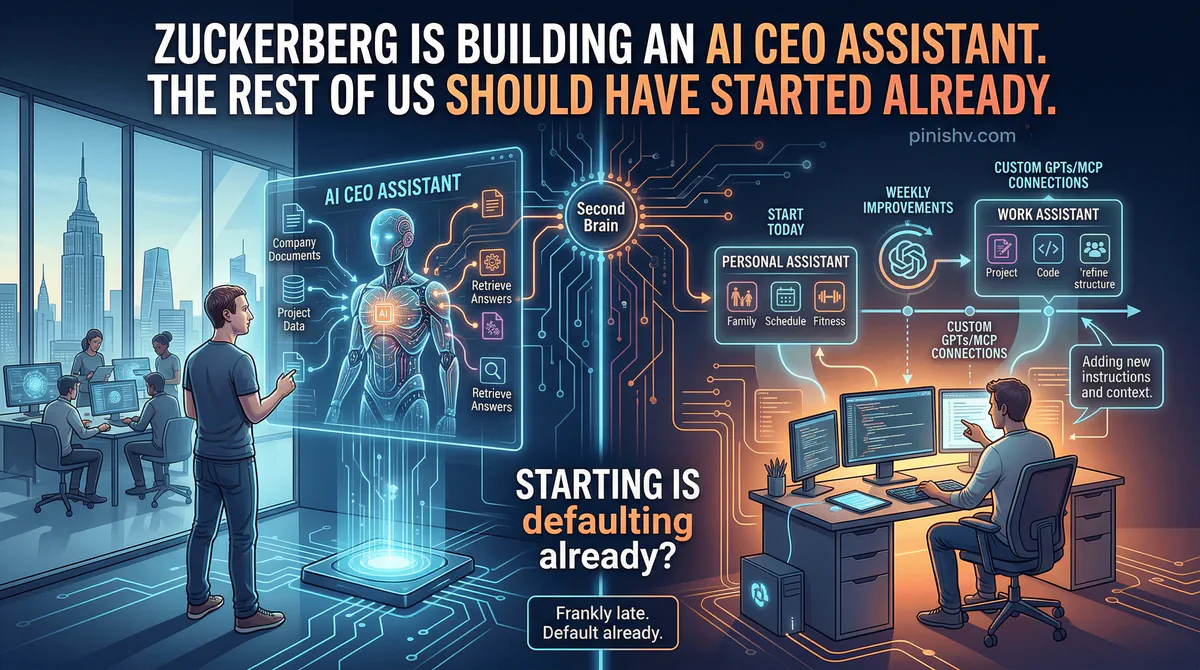
Mark Zuckerberg is reportedly building an AI agent to help with his CEO duties, according to The Wall Street Journal. The agent is in training and already retrieves answers that would normally require coordination across multiple teams. Meta is also building an internal tool called “Second Brain” that searches and organizes company documents and project data.
Meanwhile, Anthropic’s Dario Amodei is calling AI a “general labour substitute.” Sundar Pichai said AI could replace him within a year. Sam Altman said AI will “do my job better.”
CEOs of AI companies are telling you that AI can do CEO work. And now the CEO of one of the largest companies on the planet is building exactly that.
My take#
My honest reaction: this feels late.
I’ve been running two AI assistants for a while now. One for personal life, one for work. They’re not products I bought. They’re systems I built and keep building. They’re always a work in progress.
The way it works is simple. Every time I run into a new challenge, a new type of decision, a new workflow that keeps repeating, I don’t just solve it once. I teach the assistant how to handle it next time. I update the instructions, add context, refine the approach. The assistant gets better not because the model improved, but because I gave it better structure.
Over time, the assistant becomes a reflection of how I think about recurring problems. Not a replacement for my judgment. An amplifier of it. It handles the retrieval, the first-pass analysis, the pattern matching across things I’ve already decided before. I handle the exceptions, the judgment calls, the things that actually need me.
This isn’t exotic. The tools are available to everyone. Claude, ChatGPT, custom GPTs, MCP connections to your actual systems. The barrier isn’t technology. It’s the habit of investing fifteen minutes every time you solve something to make sure the assistant can handle similar situations going forward.
That’s what Zuckerberg is doing. He’s just doing it with a team of engineers instead of on his own.
Why this matters beyond CEOs#
The framing in the news is “AI CEO assistant.” That makes it sound like an executive luxury. It’s not.
Every knowledge worker who makes decisions, coordinates across teams, retrieves information from multiple sources, and handles recurring workflows is doing work that an AI assistant can partially absorb. Not replace. Absorb. The routine retrieval, the context gathering, the first draft of a decision framework.
The people who build these systems early compound the advantage over time. Every week the assistant gets a little smarter about your specific context. Every month the gap between “using AI occasionally” and “having an AI system that knows how you work” gets wider.
Zuckerberg making news for building this tells me most people haven’t started. And that’s the real story. Not that the CEO of Meta is doing it. That most people aren’t, when they easily could be.
If you’re waiting for someone to build the perfect AI assistant product for you, you’ll be waiting a long time. The best version is the one you build yourself, iteratively, by teaching it how you actually work.
Start today. It doesn’t need to be good on day one. It needs to exist. You’ll make it better every week.
Building your own AI assistant system? I’d love to hear how you’re approaching it. Find me on X or Telegram.